
An artificial bedtime story
When life becomes too convenient we stand to miss out on something precious

The A-word
I am reluctant to write about artificial intelligence. I have mixed feelings about it, and I know some of my friends, especially the creative ones, have very strong feelings about it, none of it positive. My intention here is not to alienate anyone, but to just get one person, just one, to think before reverting to AI when things become tough, when you are tired, or when life demands creativity from you.
AI may well be becoming the next self-medication that we will be grabbing for to mute out a real experience or to avoid dealing with life.
I am confused about AI, having a brother who is at the sharp end of it, a sister who has had her hard-earned acumen partially commoditized by it, and a daughter who keeps telling me I am killing more and more trees every time I ask it to solve a problem for me. It is fair to say that when it comes to AI I am not the eldest daughter, but rather the middle child with all its connotations.
Girls and ponies
I attended a large conference in May where several presentations involved the musings about the possible impact of AI on our lives, on jobs, and the way we work. New threats and opportunities were listed, and the overall message was that it was here to stay.
I had an experience that rocked me to the core during one of the breaks. I was chatting to a man, probably in his thirties.
While we were making small talk about the latest presentation, he stunned me by proudly saying that he used ChatGPT to make up bedtime stories for his young daughters. He found it really useful, especially after a long day. While I was digesting this, he continued.
‘I ask them what they feel like hearing then I feed it in. It is usually about a girl with a pony’.
He must have seen the horror on my face. The conversation ended shortly afterwards, and I cannot remember what I said. I had dropped into a whirlpool of memories.
Of warmth and shoulder-to-shoulder coziness.
Of beautiful unique illustrations with pen strokes made by a real hand on the page.
Of reading and re-reading The Gruffalo.
Of family stories being passed on, even the weird ones.
Of the day my mother had a stroke and all those stories I never heard were lost forever.
Of everyday sightings of a squirrel turning into a road safety chat.
Of falling asleep next to a toddler, the upended book a bridge between you on the duvet.
Guess how much
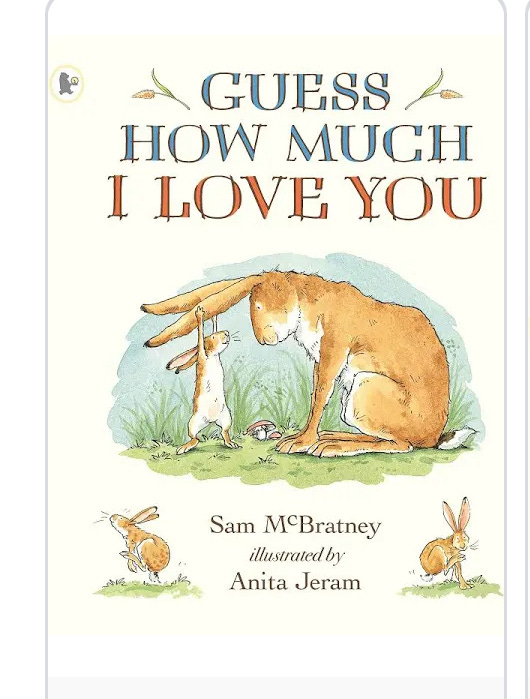
Photo Credit: Anet Ahern
A few weeks later I was in the airport at Santiago de Compostela. A book caught my eye. It was ‘Guess how much I love you’ by Sam McBratney. It was printed in 1994. While it spawned millions of (nauseating) social media ‘to the moon and back’ posts over the 31 years that it has been in print, it is a beautiful book.
I was taken back to the conversation about the AI generated girl-and-pony stories as well as my time with a young child in the early 2000’s.
The book is about a son rabbit and a dad rabbit who try to outdo one another in their declaration of love for each other until in the end the winner says ‘I love you to the moon and back.’ And the young rabbit cannot beat that.
I often read this story to my daughter, who is now 23, when she was little. It led to our own competition, and it went like this:
‘How much do I love you?’
‘Too much to explain’
‘I love you more than too much to explain’
‘I Iove you more than more than too much to explain’.
And so it went on until we started laughing, or one of us said ‘more than all that.’
Why did this encounter with the AI storyteller rattle me so?
I think it was because I felt like something precious was being ripped away. Something that you can never experience again, slipping between your fingers for the sake of convenience.
When you read to your child from your phone, you are probably not looking at them. Notifications distract you and there are no pictures, or they are tiny and strangely similar.
You don’t feel the pages in your hands.
When you read a book, you can cuddle up next to them so that they can see the words, and the story. And some of the best bedtime stories are old favourites where you turn the page as if you don’t know what is coming, and even if you do, the anticipation is delicious.
When you read a book sitting next to your child in the bed, you can look down at them and they can look up at you, and you touch.
The delightful pressure of having to pick just one book from a pile with some old favourites and some new, strange ones, is something that should never be taken over by a split-second AI process. What to choose, which voice does dad do best, how do I feel tonight?
And then there is the made-up story, which will elude the best AI machines forever.
And the modern day version of folklore. Like the one about Granny’s ‘different’ (we don’t say crazy anymore, do we?) aunt who would only drink her coffee when the cup was so full that the meniscus (big word) formed a convex shape, staring at it from the side to be sure?
What did they wear in those days, there was no TV, what did they eat? Why was she so different?
Or the time Granny wanted to put on her gumboots and one felt heavy and she shook it and a puffadder fell out?
Or how mom felt when she first felt you kick?
Or making up stories together about the day, what you were pleased about, what bothered you, what you think you could have done better, what you hope for?
I have always embraced technology, and I use AI for sure. But as with any disruption, there are gains and losses. And it would be an eternity of sadness if we allow storytelling and reading to lose its soul in the process.
Discovering books is such a privilege and a joy. (One minute watch)
Find other uses for AI. Find a child to read to. Bask in the joy of sharing a book.